








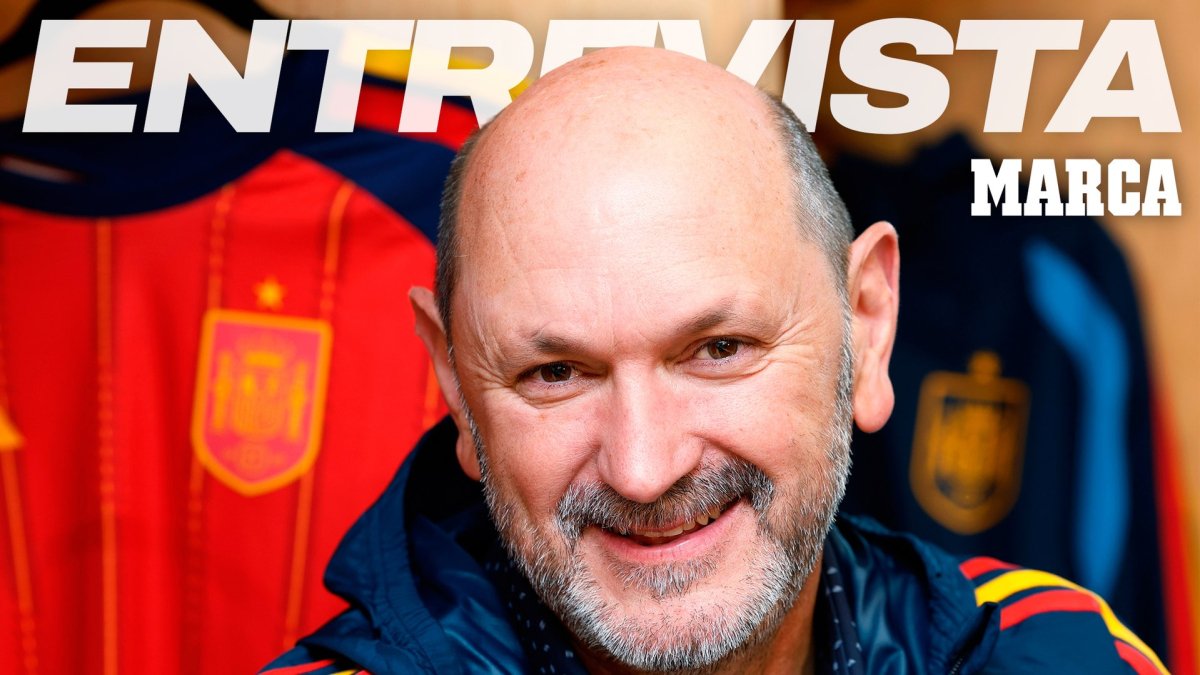
Less than 24 hours before the World Cup final against Argentina at the MetLife in New Jersey, the president of the Royal Spanish Football Federation, Rafael Louzán, speaks to MARCA from the Spanish concentration. The Galician leader, a native of Ribadumia, faces his first World Cup event at the head of the Federation with the hope of winning the second star for Spain, 16 years after the 2010 South Africa title. In this talk he reviews the meaning of the match, the figure of Messi, the frustrated Finalissima against the Albiceleste, the unifying power of the team and his firm commitment to the 2030 World Cup final being played in Madrid with De la Fuente as coach.
Ask. President, what does today’s appointment mean? What is it for that kid from Ribadumia?
Answer. At the moment I am living it absolutely naturally, because it is the first experience I have being present at a World Cup. In 2010 I remember perfectly where it was, in the Plaza de Pontevedra, where we all lived there together. Curiously, it was the same square where we experienced the world championship that the girls won in Australia, with Teresa Abelleira’s grandparents and four or five thousand people.
I hope that tomorrow we will complete another great feat for Spain, which is a second victory in a World Cup. Furthermore, this gives us another projection. The one in South Africa was the first and something incredible, but this one, because of the place where it happens, because of the trajectory of this team and because of the solvency that these players and their coach, Luis de la Fuente, are showing, gives us a lot of confidence in what may happen.
Q. If you look back, did you imagine that you could be president of a Spanish Federation that could be world champions?
A. As things happen in life, perhaps you hadn’t thought about it. But if it is necessary and I could take on this challenge, I am always willing. There are no things in which I limit myself. In everything that comes, we have to be prepared. Life always puts challenges before us, both with significant degrees of difficulty and with great satisfaction. And this joy, which could be tomorrow, I wanted to share with all of Spain, and especially thank this extraordinary family of players, who will leave us a wonderful legacy.
Q. In this often tense Spain, the national team unites a lot.
A. It is what unites the most in Spain, precisely the senior team, both men and women. Women’s football has grown spectacularly and is already qualified for next year’s World Cup in Brazil after a great victory against England. What the whole of Spain is experiencing, from what they show me, is impressive. May that emotion, that illusion that Spain needs, serve to continue uniting our country. And I hope it is also the foreshadowing of many great things.
I must not forget that we have just been European champions for men and women, and also European champions for men’s and women’s futsal. It is an incredible trajectory. This is due to everyone who makes Spanish football possible, from the fans to the institutions and companies that support the sport. That we continue along this line will be very good for Spain.
Q. Is this World Cup final a bit like that Finalissima that couldn’t be played? Spain always said they wanted to play it, Argentina also said they wanted to play it.
A. It seems that fate has decided that this had to be celebrated. Spain stated publicly and privately that it wanted to play. Wherever. He never said no to Madrid, Lisbon, Rome, London or any other place. It was planned to be played in Qatar and could not be played due to the war. From there we activated our maximum availability so that it could be played as it were, but there was no possibility.
In any case, fate has wanted it to be played on another stage and for a double title, a world championship. And also, with an aspect that makes me, as a Spaniard, feel very good: this World Cup final speaks Spanish. And that doesn’t happen every day. The last time was 96 years ago, in that final between Uruguay and Argentina. For the whole world to see that there are 22 players speaking Spanish on the field is a very great satisfaction.
Q. To settle that issue, would you have gone to play with Argentina in two games?
A. Yes. There was an approach offered for a round-trip match, and we were willing. Spain is always willing to compete wherever it has to. Furthermore, it is the mentality of the coach himself. I have never heard Luis say no to any challenge. Never.
Q. Is there anything about Argentina that is scary, in quotes? I’m talking about all this cancherismo that has been talked about these days. What version do you have?
A. You have to have great respect for this team, because what Argentina is doing, led by Messi, is something to be proud of. I never talk about arbitrations. Whether they are very keen or whether they have a particularly enthusiastic fan base, they are probably the most enthusiastic on the field.
But our way of proceeding, as presidents of different federations told me these days, is very popular. They like the humility of Spain, the way of understanding football as a team. Argentina also conveys other things: that they are there until the last moment and have achieved very notable victories. But I think that rapport and that Spanish talent should lead us to victory.
Q. As a football man, what is Messi?
R. Messi, along with Cristiano Ronaldo, is at an extraordinary level. I don’t like to go into who is better or worse, there are two references. Messi’s technical quality is incredible, and also his humility and how he has worked for his teams and for the Argentine national team. The legacy he leaves us is wonderful, and for the good of football we must be extraordinarily grateful to him.
Q. I wanted to ask you about all those people who are going to come from Spain even if they are not among the 26 chosen. Can you give us a name?
A. Here is the maximum representation of our country. The king and queen, and also their daughters, who had already told me in Guadalajara that they wanted to see us in the final. There will be the President of the Government, the President of the United States and the maximum possible representation for a final like this.
I would have liked as many Spanish fans as possible to be here. It is not possible due to the distance, the operation and the price of the tickets. But we understood that there should be an important representation of Spanish football: we have invited professional and national clubs through a draw among hundreds of teams, workers and managers of the Federation, LaLiga, AFE and League F, although in the end they will not be able to be there.
There will also be the legends of Spanish football, coordinated with FIFA, and our world champions. They participated in the first and also want to participate in this possible second World Cup. This goes through Spain and for Spain. And we owe it to this wonderful group of players and our coach along with his coaching staff, who have given us back an illusion that the country needed.
Q. Allow me one last trip back in time. End of 2030 in Madrid and with De la Fuente?
A. Yes. I think he more than deserves it. And the other thing doesn’t deserve much discussion either: that grand final must be in Spain. We have led the candidacy, although I was not there then, and Spain has plenty of organizational capacity to have a great World Cup. Probably the one for the centenary and the best in history. Of course, we must thank the United States, Canada and Mexico, and FIFA, for the treatment received and the magnificent organization. The bar is very high. Now it’s time to observe, learn and see what we can improve and contribute in Spain.
It must be a tremendously cohesive candidacy. There can be no divisions. The strength will be in the cohesion of Spain, Morocco and Portugal, and also Argentina, Paraguay and Uruguay. There are three continents and six countries united to make the most memorable World Cup in history.
Q. And the last one: cheaper tickets?
A. Yes. We are in the United States, the country with the highest per capita income in the world, and when that argument is visible, with the stadiums full, you can say little else. I would like there to be greater economic accessibility for fans, who expect a World Cup every four years. But the per capita income in Spain, Morocco or Portugal is not what it is here. I want to understand that FIFA will take this into consideration to make this World Cup more accessible.
Furthermore, the distances between these three countries are reasonable from an organizational point of view. And there is a very special consideration towards Montevideo, where the first World Cup was held in 1930. That Latin family unites us and links us deeply.