





















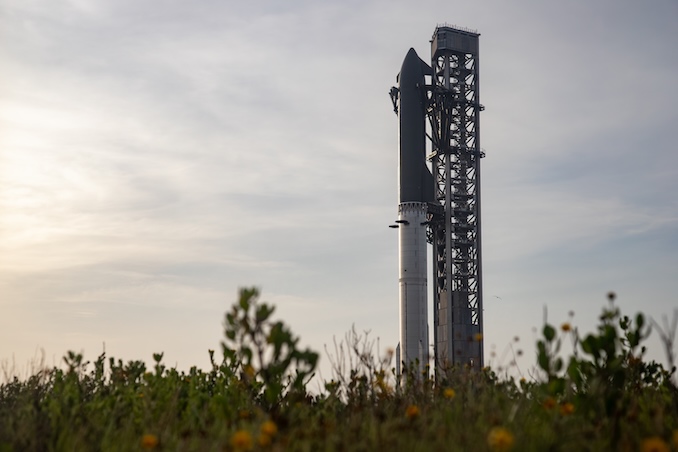
Update July 23, 4:10 PM EDT (2010 UTC): SpaceX has abandoned the launch attempt due to weather; the target was July 24.
SpaceX will once again attempt to launch its Starship Super Heavy rocket from South Texas, but not until Tropical Storm Bertha passes through Texas.
As with the attempt a week ago, the 90-minute launch window will open on Friday, July 24 at 5:45 PM CDT (6:45 PM EDT / 2245 UTC). The flight came after several days of work replacing and testing multiple Raptor engines on the Super Heavy booster.
Spaceflight Now will begin live coverage approximately two hours before liftoff.
Shortly before the post-ignition abort on Thursday, July 16, telemetry data on the screen showed that four engines were apparently not firing. In the predawn hours of Friday, July 17, the Ship 40 (S40) was unloaded from the Booster 20 (B20) and returned to Starbase’s production facility.
Later that day, SpaceX also dismantled the B20 and rolled it nearly three kilometers back to the production site. Founder Musk said at least two Raptor engines will need to be removed after the engines hard stopped during the launch attempt.
After a week of work, the B20 returned to Base 2 on Tuesday, July 21st. The next day, SpaceX loaded it with liquid oxygen and liquid methane, then emptied the vehicle again.
After the test, SpaceX posted on social media: “Additional pre-flight testing of the Super Heavy aircraft has been completed. Preparations are now beginning to launch Starship as soon as tomorrow (Thursday, July 23).” “Weather is an important watch item for the current launch.”
Ship No. 40 returned to the pad on Wednesday, July 22, and was stacked on top of Booster No. 20 that evening.
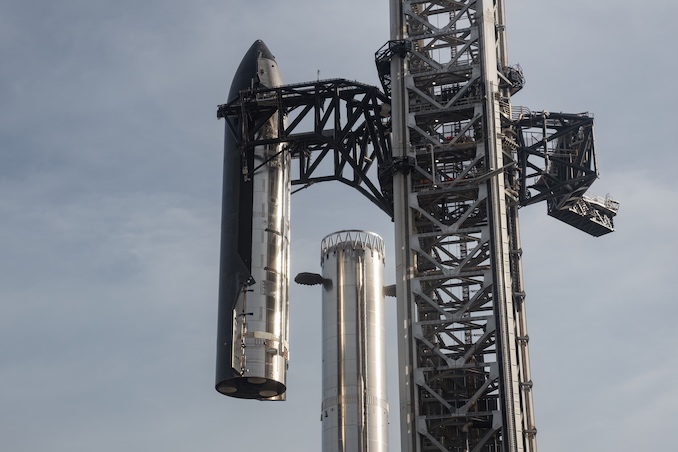
One of the main goals of this 13th test flight is to deploy 20 Starlink V3 satellites from S40. SpaceX has previously deployed Starlink simulators on previous Starships, but this will be the first deployment of a production satellite.
“As part of initial testing, Starship plans to deploy 20 satellites that will expand solar arrays and antennas and attempt to connect to the larger Starlink constellation via high-capacity lasers,” SpaceX said on its website. “Starlink satellites will be in the same suborbital orbit as Starship and are expected to die approximately 20 minutes after deployment.”
SpaceX also plans to reignite the Raptor engines after the roughly 11-minute satellite deployment sequence. The team also hopes that work completed on the sea-level Raptor engines, combined with a new startup sequence for the ship’s upper stages, will allow Booster 20 to successfully boost burn and splashdown in the Gulf of Mexico.
During Starship Flight 12 in May, SpaceX said the startup sequence of the engines on board Spaceship 39 “caused the booster’s direction to flip approximately 90 degrees.” Coupled with problems with five of the booster’s 33 sea-level engines that prevented the nominal booster burn, Booster 19 was lost prematurely.
“This upcoming Super Heavy aircraft has hardware modifications to improve relight reliability and updated engine alerts and aborts to accommodate conditions in a multi-engine flight environment,” the company said.
Other engine improvements were designed to prevent the premature shutdown that occurred during Flight 12, which prevented the engine reignition demonstration on that mission.
Work will also be shown on the upper heat shield to help propel it into the future, being fully reusable.
“Multiple tiles will be installed on the metal side of Starship’s rear flaps, as well as modified tiles and connection mechanisms in the heat shield covering the rear skirt to collect flight data with different connection options,” SpaceX said. “Finally, Starship’s heat shield will be equipped with load-sensing tiles to measure the pressure exerted on the tiles as the vehicle experiences higher dynamic pressures as it ascends than on previous flights.
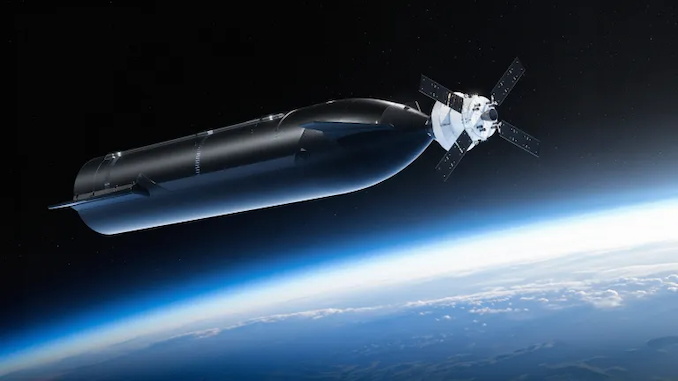
A nearly identical version of the Starship Version 3 rocket flying today will be used on the Artemis 3 mission, which will include docking between Starship and NASA’s Orion spacecraft.
A new report released Thursday by the U.S. Government Accountability Office (GAO) examines a range of NASA’s long-term projects, including those involved in the Artemis program.
It pointed to “a series of testing challenges” that SpaceX encountered while developing a version of Starship, the human landing system used to return humans to the moon. NASA hopes to land on the moon with astronauts as early as 2028 using Starship or Blue Origin’s Blue Moon Mark 2 lander.
The GAO report noted that SpaceX was not only “more than a year behind schedule” for critical events, such as critical design reviews and unmanned landing demonstrations, but the development of its Raptor engine was also described as “highest risk.”
“According to HLS officials, the latest version of the Raptor engine incorporates improvements such as welded fuel joints designed to prevent fuel leaks that caused the Starship vehicle to crash during a March 2025 flight test,” the report states. “Flight Test 12 in May 2026 was the first flight test of the new version of the engine.” “Flight Test 12 in May 2026 was the first flight test of the new version of the engine.” “The 12th flight test in May 2026 is the first flight test of the new version of the engine.”
The GAO report noted that NASA officials disputed some of the assessments and said the report’s assessment “does not reflect all ongoing program changes resulting from Artemis program adjustments in February and March 2026.”
“Officials did not make any technical corrections to the assessment,” the report said.