




















Two issues made my eyes widen to the purpose that I may have been in a horror film this week. The primary was fairly disagreeable information; the second was the factoid dropped on Saturday on the Components 1 United States Grand Prix that over 200 observe limits violations had been registered throughout one session on Friday.
Sky Sports activities known as this ridiculous situation one thing alongside the traces of “a scenario brewing.” Personally, I discovered it ludicrous that we had that many instances of arguably the 2 most cursed phrases in Motorsport – greater than the shapeshifting grass from Netflix’s Stephen King adaptation.
Fortunately, barring Max Verstappen’s second Q3 lap being deleted in any case 4 wheels of his Purple Bull left the white line, we received away with a minimal of points throughout qualifying. However the truth that we had been braced for a number of grid penalties reveals that we’ve got now moved so distant from the precept of taking a nook: a driver must enter at most pace, and take and exit the apex within the quickest doable manner.
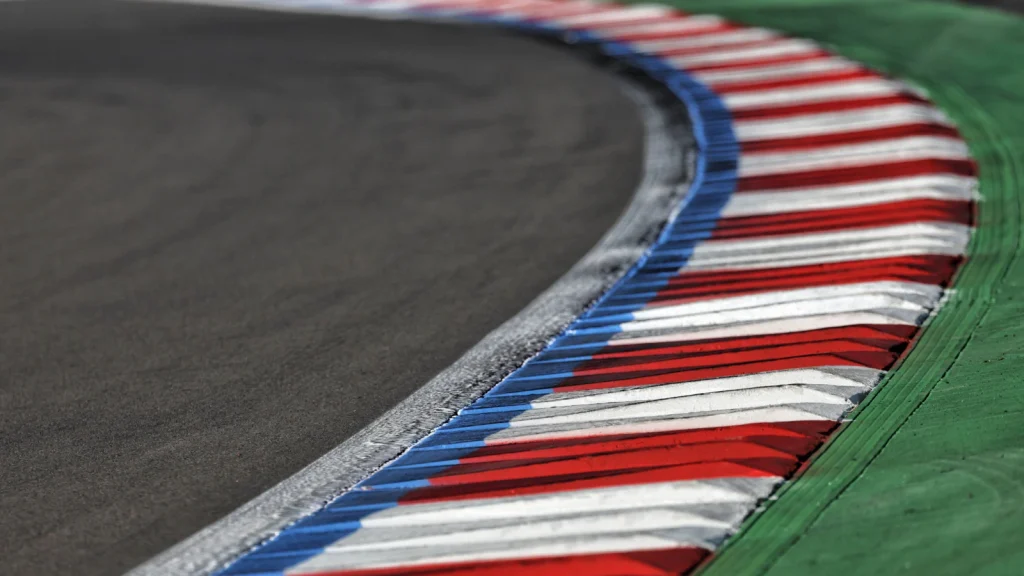
In the present day, that is now actively being punished. As an alternative, drivers are subjected to penalties if all 4 wheels depart the observe. The wording of the track-limits regulation within the FIA Driving Pointers is clear-cut and leaves no ambiguity, setting a agency stance with no exceptions.
“Drivers will likely be judged to have left the observe if no a part of the F1 Automotive stays in touch with it and, for the avoidance of doubt, any white traces defining the observe edges are thought of to be a part of the observe however the kerbs should not.”
A sluggish encroachment of white traces?
At a number of the circuits F1 visits, observe restrict points merely don’t exist. Run large at a observe like Silverstone, Spa, Monza or Montreal, and a driver has a one-way ticket to the obstacles and an ungainly debrief with their staff after the session or race, in addition to guilt for wrecking a automobile.
However within the final decade, we’ve got seen the rise of a brand new drawback at a number of the circuits F1 tends to go to – observe limits. As a lot as I cherished visiting the Purple Bull Ring, the variety of automobiles dropping lap time for violations was nonetheless unprecedented, even after the set up of gravel in sure corners.
Then there are tracks like Abu Dhabi, which, if I’m being sincere, remind me lots of a stage from the PlayStation 1 sport Crash Workforce Racing, the place you accumulate bins to freeze time in what is actually an enormous automobile park. The quantity of run-off on this circuit is large, and errors, whereas expensive, do not need the identical affect as these on the extra conventional tracks.
After all, the most important situation with run-offs the scale of a parking lot at Disneyland Paris is that it encourages drivers to push more durable over the virtually flat kerbs. A white line may be painted to mark the top of the circuit, however a driver remains to be going to go over a kerb if it offers them a greater exit out of a nook, significantly if there isn’t any consequence for the automobile itself.
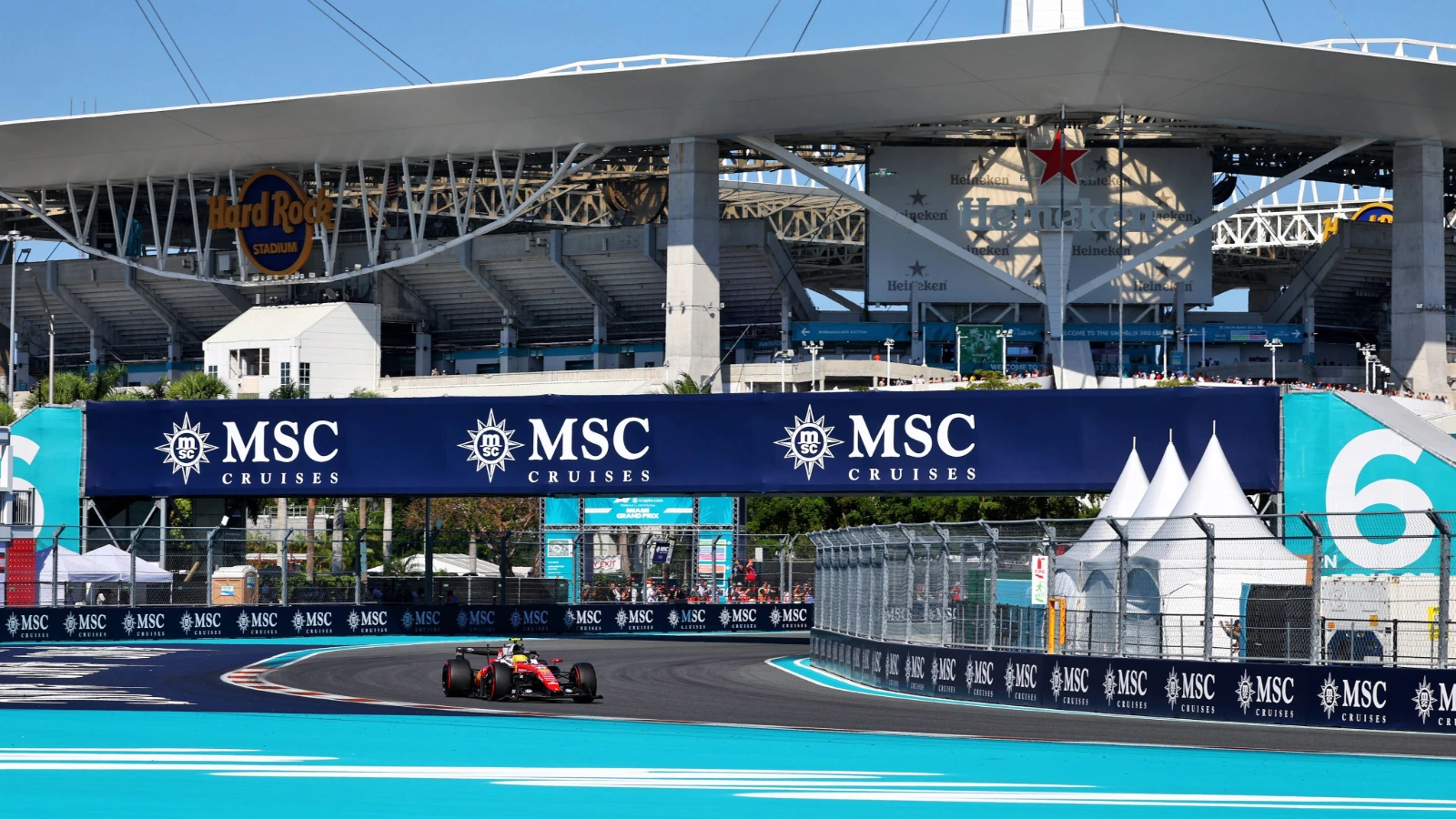
That is the one main bugbear I’ve with many trendy circuits: drivers face few penalties for operating large at corners past track-limits violations. That, to me, dilutes the spectacle and reduces the problem to the drivers. F1 ought to reward drivers who present bravery, however as an alternative, observe limits have develop into a curse that may affect outcomes on the entrance of the sector in current occasions. Miami is certainly one of these. No quantity of blue paint can masks the run-offs. Paul Ricard tried that, and that circuit actually does resemble a parking lot.
I can recall the race at Austin again in 2017 the place Verstappen was awarded a five-second time penalty for passing Kimi Raikkonen for third on the ultimate lap with all 4 wheels on a kerb. Verstappen reacted angrily, stating, “We had a extremely nice race, however with these silly choices you actually kill the game.”
A comparability to yesteryear
Wanting again, I can not recall when F1 determined to penalise drivers for daring to stray over kerbs. Today, that’s seen as sacrilege, and like many avid F1 followers, I nonetheless don’t perceive why. Everyone knows the present components: three warnings from the FIA for constant breaches, adopted by a five-second penalty. But it surely was not all the time this fashion. In reality, there was a interval within the early 2000s when automobiles had free rein, and it was totally wonderful.
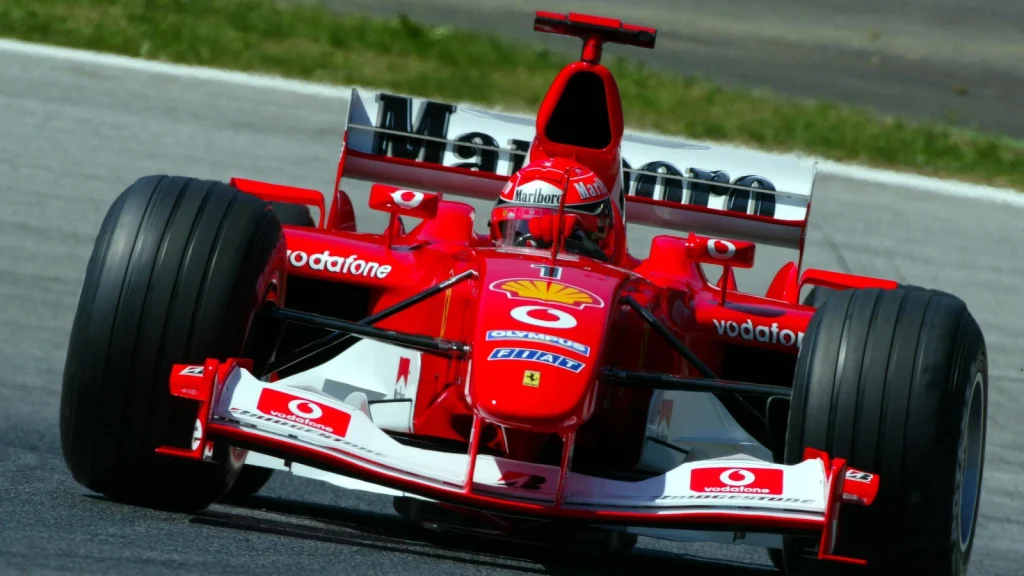
Forgive me for mentioning social media, however my sudden tangent has a degree. Two video clips are repeatedly popping up in my social media feed. One is onboard with Michael Schumacher within the F2003GA in Austria, whereas the opposite is onboard with Fernando Alonso at Magny-Cours in 2004. Each movies are qualifying laps.
Whereas the sound of the wonderful V10 engines is unbelievable, they don’t seem to be the one focus of those clips. As an alternative, it’s the full free rein the drivers have over the observe. Schumacher and Alonso are using excessive kerbs, all 4 wheels off the observe, and within the case of Alonso, having all 4 wheels properly and actually off the observe. Simply by watching, you possibly can see how a lot he’s having fun with pushing the automobile.
Then there’s Schumacher in Austria. Ascending the hill in direction of Flip 1, he runs onto the inexperienced kerbs and continues to offer as a lot energy as he can, the Ferrari V10 reacting with word modifications. The grass and gravel subsequent to him previous the quick run-off loom shut, however he judges it to perfection. In the present day, if anybody tried that, it might be deemed harmful, and the lap time would naturally be deleted. Groups would virtually go so far as to say the grass would take him.
The difficulty of observe limits lengthy existed earlier than the FIA started clamping down on it lately. As newer tracks and reprofiled corners at older tracks launched run-offs within the 2010s, race stewards started to grapple an increasing number of with drivers gaining benefits. The query needs to be requested, in fact: why did circuits or designers imagine tracks the place run-offs turned extreme had been a good suggestion to current to race drivers? It’s like dangling an enormous cake in entrance of somebody who craves it. They’ll reap the benefits of this example.
The politicisation of observe limits occurred in 2016 when the F1 Technique Group met in Geneva and voted to calm down the elevated crackdown on observe limits. Then FIA Race Director Charlie Whiting deemed this inappropriate and launched the rule set that F1 followers have come to know verbatim because of the frequency of its incidence.
Is there a manner again?
In a nutshell: no. The rightful clampdown on security means drivers are extra sorted than they ever have been. However the borderline excessive transfer to extreme run-offs has diluted the present; there isn’t any getting away from it. Sure, drivers can proceed in the event that they make a mistake, however they’re additionally not being punished for errors. And naturally, the one factor they’re punished for is daring to cross a white line.
There may be a solution to this quandary. Properly, two really: reintroduce grass and gravel – although not the nasty shapeshifting type. It’s no coincidence that racing is best at circuits like Melbourne and Silverstone, the place drivers are punished for errors, together with operating over the kerbs an excessive amount of. Run large at old-school circuits and a observe limits violation is the least of your issues.
However there’s hope {that a} compromise may be reached to police drivers searching for a bonus vs the spectacle struggling. I discussed Austria putting in gravel at sure corners: this had the beginning of the specified impact. Drivers prevented being grasping, or threat damaging their automobile. I harbour hope that this may be rolled out to different circuits, like Abu Dhabi. Not each observe can have this although. Baku, for instance, is nice as it’s, and wishes no artificiality added.
In the present day’s automobiles are heavier, so a return to the clips seen from the early 2000s is unlikely. However I’d argue that as F1 continues to grapple with laws which are dividing the fanbase, the straightforward introduction of grass and gravel may present a plaster to a 12 months dogged by issues. It gained’t resolve F1’s present predicament, however may stop groups from having their very own eyes open on stilts after they see their driver topic to a penalty. Being caught within the lengthy grass is preferable to concrete, no.
READ MORE: Has F1 misplaced its sense of moist climate journey?