

















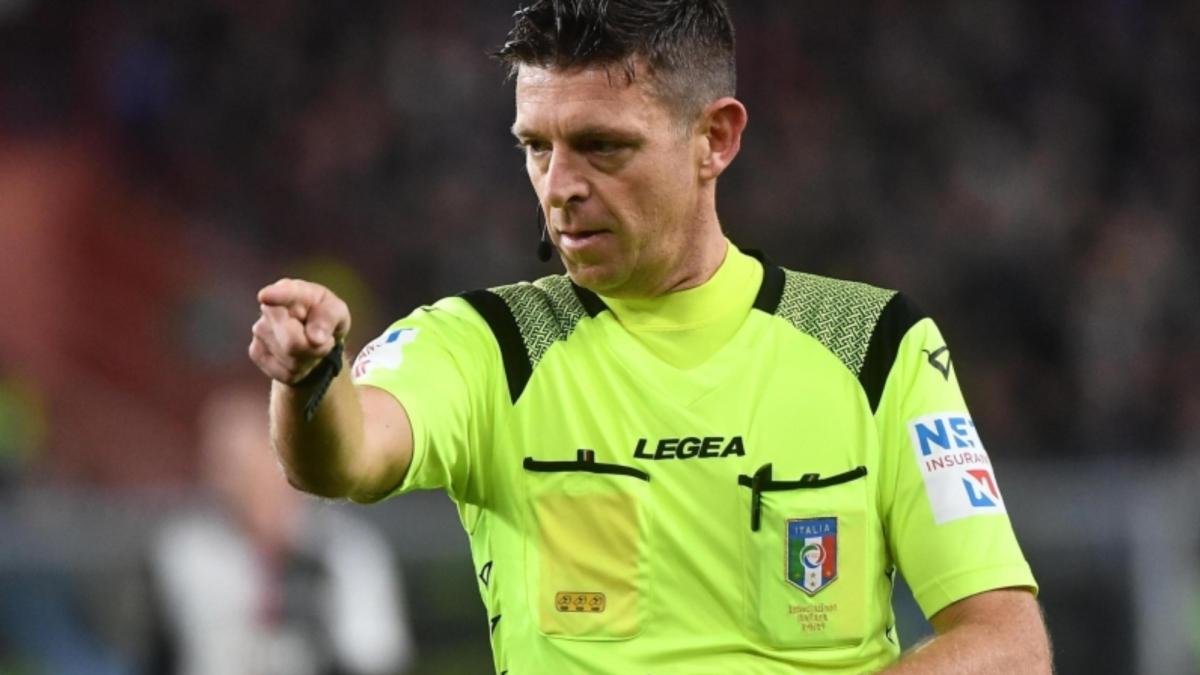
He Calcium He looks at himself again in the mirror he fears the most. In Italy, case Gianluca Rocchi has opened an unexpected crack in the final stretch of Serie A. The referee designator of Serie A and Serie B is being investigated by the Milan Prosecutor’s Office for alleged “complicity in sports fraud”. Rocchi, who denied any wrongdoing and has immediately suspended himself to face the cause, threatens to become the great institutional fire of Italian football.
Now a key element that could set the course and relevance of the arbitration investigation related to Inter. It takes place at a specific time and place: April 2 at San Siro. The focus is on the appointment decisions made by Rocchi for the Bologna-Inter (with Andrea Colombo as referee) and Inter-Milan (with Daniele Doveri) matches. Today, both referees have testified before the Prosecutor’s Office as people aware of the facts, ignoring the reasons why they were assigned those matches.
However, an important unknown remains. Some witnesses—all of them belonging exclusively to the arbitration field—mentioned the term “combined designations”. But what exactly does this concept imply, taking into account that the person responsible for assigning referees is free to do so at their discretion? In the Gazzetta dello Sport HE They expose the different plots that would explain the investigation after the statements collected for it.
Was it done to favor the referees themselves?
According to various statements collected by the Milan Prosecutor’s Office, there would have been a so-called ‘Rocchi system’. This would be based on a favoritism model, in which appointments would have been used to boost the career of certain referees to the detriment of others. These would be internal power dynamics of the arbitration team, without intervention from the clubs.. The designator’s decisions would have had an impact on internal votes and possible sanctions. The referees considered “like-minded” would have continued to receive matches—including high-level matches in Serie A—which also implies economic benefits.
These important matches They would function as a reward for those who followed the marked line, like other advantages within the system. On the contrary, those who did not conform to this scheme would have been separated or harmed. In fact, the complaints come mainly from referees or former referees who consider themselves harmed by these decisions, either by exclusion or by having been singled out.
The option of satisfying some clubs
Another branch is that the Designations did not respond only to internal arbitration criteria, but also to factors related to the clubs, such as relationships or assessments of the suitability of certain referees.s. In this case, it would be necessary to analyze whether the designator himself was able to obtain any indirect benefit.
Different hypotheses are being considered: for example, that assigning certain referees would serve to avoid conflicts with the clubs or protect referees from compromising situations (such as returning to direct a team that they had previously clearly harmed). The possibility is also contemplated that An attempt will be made to favor certain clubs, although there is no evidence to support it.. So far, no representative of Serie A clubs has been questioned or listed as under investigation, and the key conversation at San Siro would have occurred only between members of the refereeing environment.
For research to prosper, The Prosecutor’s Office would have to prove that Colombo and Doveri were chosen because they were referees considered “favorable” or “unfavorable” for Inter, something that, for the moment, no testimony has confirmed.