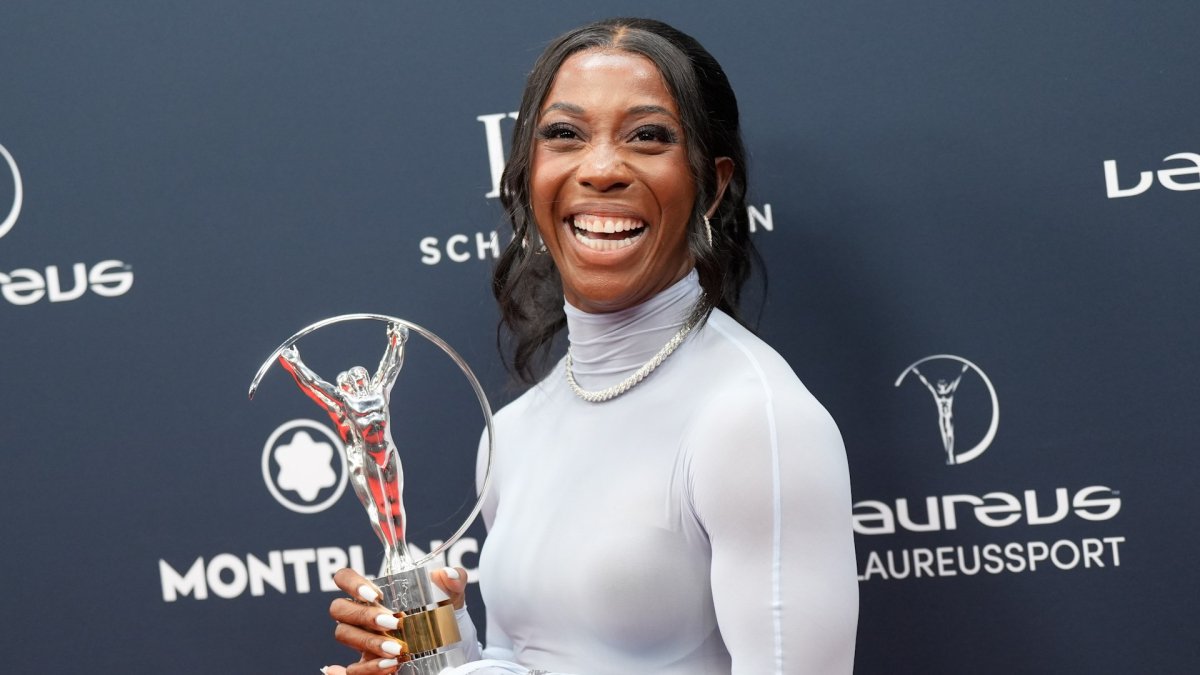
Shelly-Ann Fraser-Pryce (Kingston, 1986) – ‘Pocket Rocket’ for athletics lovers – sings while the cameraman places the microphone on her for the interview and says goodbye with a huge smile and an “arrivederci” thinking that she speaks Spanish. In other words, she no longer sports the spectacular and colorful wigs with which she competed but she is still the life of the party as recent ambassador of these Laureus awards who have visited Madrid for the third consecutive year.
ASK. How do you feel after your retirement from professional athletics after the Tokyo World Cup?
ANSWER. I feel good. I mean, after 18 years doing something, it’s normal that you miss it, because it was like a routine: getting up in the morning and going to train. And I really enjoyed doing it. Now I am a full-time mother, I collaborate with foundations and charities and I get involved in my businesses and the different projects I have at home.
I feel lucky and grateful to have achieved so many things. Who would have told me that I would become the third fastest woman in history and reach the final of a world championship at 38?
Q. You had an incredible career for almost two decades with three Olympic gold medals and ten world championships. Do you feel like you were missing something to achieve? Maybe a world record?
R. No, the truth is that I don’t think I missed anything. Honestly, as I reflect on my journey, I feel lucky and grateful to have achieved so many things. Who would have told me that I would become the third fastest woman in history and reach the final of a world championship at 38?
Shelly-Ann Fraser-Pryce poses for MARCA on the day before the Laureus gala in Madrid.CHEMA KING
Q. What is the performance that you have the best memory of?
R. I’ve had so many… Maybe my first Olympic gold medal (Beijing 2008) is the highlight because it cemented my idea of what hard work and self-motivation is. I also highlight my return after having my son in 2019 and winning that world title in Doha. Because in a world where women are often told they have to choose, motherhood helped me evolve as an athlete and as a person.
Q. There are fans who question the cleaning of Florence Griffith Joyner’s 100 and 200 meter world records. What do you think?
R. The truth is that I try not to think about it because reality is what it is and there is nothing I can do about it. That is why during my career I always focused on my talent, maximizing it and working hard to always be at my best. The world record is something that all athletes work for and it becomes a motivation. In my case, I simply psyched myself up so that every time I stood at the starting line I felt like I was one step closer.
I am left with my first Olympic gold medal (Beijing 2008) and I also highlight my return after having my son in 2019 and winning that world title in Doha
Q. Do you think Melissa Jefferson-Wooden has the potential to break both records in the future?
R. The truth is that I don’t know. I think Melissa had an extraordinary performance last year – gold in the 100 and 200 at the World Cup in Tokyo. Her case shows that an athlete can have a good season – she won Olympic bronze in Paris in the hectometer – and use it as a springboard for the next. Once you put in the effort, you are able to make changes, adapt, and correct the things you think you need to get to that point.
Q. Last year at the World Relays in Guangzhou, the Spanish women’s 4×100 won twice – in heats and the final – against a Jamaican relay that included you. How do you value it?
R. I like it when nations bring in teams looking to make history. They look for a moment that will stick in their memory for years to come, because they gave other athletes the opportunity to believe they could do it too. Those girls have given their country’s athletes, you know, the opportunity to dream and say, “Okay, I can be here too.” As a collective, we can come together and make history, not only for ourselves, but for our country.
I like when nations like Spain bring replacements that seek to make history. They look for a moment that will stick in their memory for years to come, because they gave other athletes the opportunity to believe they could do it too
P. Rafa Nadal always says that the rivalry with Federer and Djokovic made him a better tennis player and that perhaps without them he would not have won so much for so long. You had your compatriot Elaine Thompson-Herah – five-time Olympic champion – as a great challenge throughout your career but Usain Bolt perhaps had no one.
R. Usain is a once in a lifetime talent. It’s true that he never had anyone who challenged him much but I think he had good competition that forced him to understand that he had to work hard to win. Usain is one of those athletes who never took anything for granted. He is a phenomenon of this sport and what he achieved is simply extraordinary and incredible.
Although on paper, he probably didn’t see any rival who could eclipse his legacy, that never stopped him from giving 100% and trying his hardest. And that is the reason we have the world records that we have to this day. It doesn’t matter if you have a big rival or not, you should always make sure you give 100% all the time.
Usain Bolt is a once-in-a-lifetime talent but he is one of those athletes who never took anything for granted. It’s true that he never had anyone who challenged him much, but I think he had good competition that forced him to understand that he had to work hard to win.
Q. But don’t you think that the absence of that great rival in some way prevented you from running even faster?
R. Personally, I think that if he had stayed on the track a little longer – Bolt retired days before his 31st birthday – he probably would have run the 200 under 19 seconds, who knows, because he would have been more motivated, since in the last stage of his career, as you know, it required a lot more work and dedication. And I think also in that last stage, maybe he got a little bored at the end. Because the closer someone is to you in terms of your times and achievements, the harder you work. So who knows what results he would have gotten?
Shelly-Ann Fraser-Pryce after winning World gold in the 100 meters in Eugene 2022.LAPRESSE
Q. Do you think that the figure of Mondo Duplantis can now be compared to that of Usain Bolt?
R. It’s different. Mondo has done extraordinary things because every time he jumps you think he is going to break a world record. It’s crazy. He is breaking his own record time and time again. I can’t say how hard it is because I’ve never held a pole but as sprinters, we only get one chance. You understand me? And it’s speed or nothing. That doesn’t take anything away from his achievements, but on the pole you have many different opportunities. You know, he’ll do a first jump and probably adjust something with his coach and say, “Oh, I need to change this.” In sprinting, you simply have to run. There’s no chance to go back and say, “Okay, let’s repeat the race because I think I made a mistake.”
Q. Last week, the World Athletics Nationality Review Committee rejected 11 nationality change requests that Türkiye had requested, some of them from Jamaican stars. What do you think?
R. World Athletics (WA) sets rules for the benefit of our sport and to ensure a level playing field. But at the same time, we must understand that athletes have a limited time in their professional career. If a standard is demanded of them, it must also be demanded of their federation, because athletes cannot be treated as merchandise. They are athletes who chase dreams, who seek to make a living and who have families to support. The reality is that many of them find themselves in situations where they do not receive the necessary help. As athletes we need support because we are expected to perform at world-class levels and, more often than not, we do not receive world-class treatment.
If World Athletics establishes a standard to be able to change nationality, it must also be required of its federation, because athletes cannot be treated as merchandise. They are athletes who chase dreams, who seek to make a living and who have families to support. The reality is that many of them find themselves in situations where they do not receive the necessary help.
That is, when you apply those rules, you also have to hold the federations accountable for how they treat their athletes and why the athletes want to leave their respective countries. Athletes don’t leave places if everything is going well, if everything is perfect. Athletes make decisions about their careers because it is their time. It is a limited window in which they have to make decisions. So for me, it’s two sides of the coin.
I understand the position WA takes because they are trying to preserve the integrity of the competition and all that. But at the same time, as an athlete, I understand what support is and what it means for athletes chasing Olympic glory or world championship titles. I understand all of that and I understand the power of support. And if you have a federation that is not doing enough to ensure that its athletes receive the necessary attention, that they are given the right tools, resources and support to perform at their highest level, then those conversations are necessary too.
Yamaha outboards are renowned for their impressive speed and performance on the water. Whether you’re looking for a powerful engine for fishing, leisure cruising,...
7 Shocking Facts About Yamaha Outboard Motor Prices in 2025 Meta Description: Yamaha outboard motor prices range from $1,000 to $55,000. Complete 2025 pricing...
ss=”rank-math-highlight” style=”background-color: #fee894″>Linda Noskova from the Czech Republic pulled off an impressive upset to secure her place in the semifinals of the prestigious Bad...